

The Quiet Stall
You are holding a position that has stopped moving. The board pack says on-plan. The clock says nothing. And nothing is the most expensive sound in your portfolio.

You know the position before I describe it, because you are already thinking about it. The one that isn’t failing — failing would at least be clear — but has quietly stopped moving. Revenue flat two quarters running. The founder calls shorter than they used to be. The milestone slide carries last quarter’s milestones under this quarter’s names. The board pack says on-plan, because mid-raise it has to. And it sits in the quiet middle of your portfolio review, where the positions go that no one has a sentence for.
The silence around that position feels like patience — like time you are generously extending while things sort themselves out — but time is not neutral to a stalled company in this sector. A hardware-and-software company that has stopped moving is consuming bridge capital while its strategic value decays, and there is a buyer who understands the decay perfectly: the acquirer running the salvage screen, the one party at the table with no clock at all, for whom every undiagnosed quarter is a discount. Your silence is their entry point. You experience it as waiting. They experience it as a sale slowly coming to them at a better price.
So the question that matters about the stall is not how much longer do we give it. It is what is actually holding it still — and this is where the quiet stall splits into two companies that look identical from the outside and could not be more different underneath.
The first company has a locatable, fixable cause. A production model built for a volume it never reached. A commercial architecture that worked at the pilot scale and shears at the real one. A seat in the leadership team that was adequate before the load and is failing under it now. These breaks are specific, and specific breaks can be cleared. For this company, a bridge with the fix attached is one of the best trades in the portfolio — modest capital, a repaired position, a restored mark, and an investor letter that reads like discipline rather than apology.
The second company looks the same from the outside and is not. Its cause is structural, and no intervention you can fund clears it. For this one, the bridge buys six more months of the same fracture, a deeper entry for the salvage buyer, and a mark you will eventually explain twice — once when it falls, and once when someone asks why fresh money went in ahead of the fall.
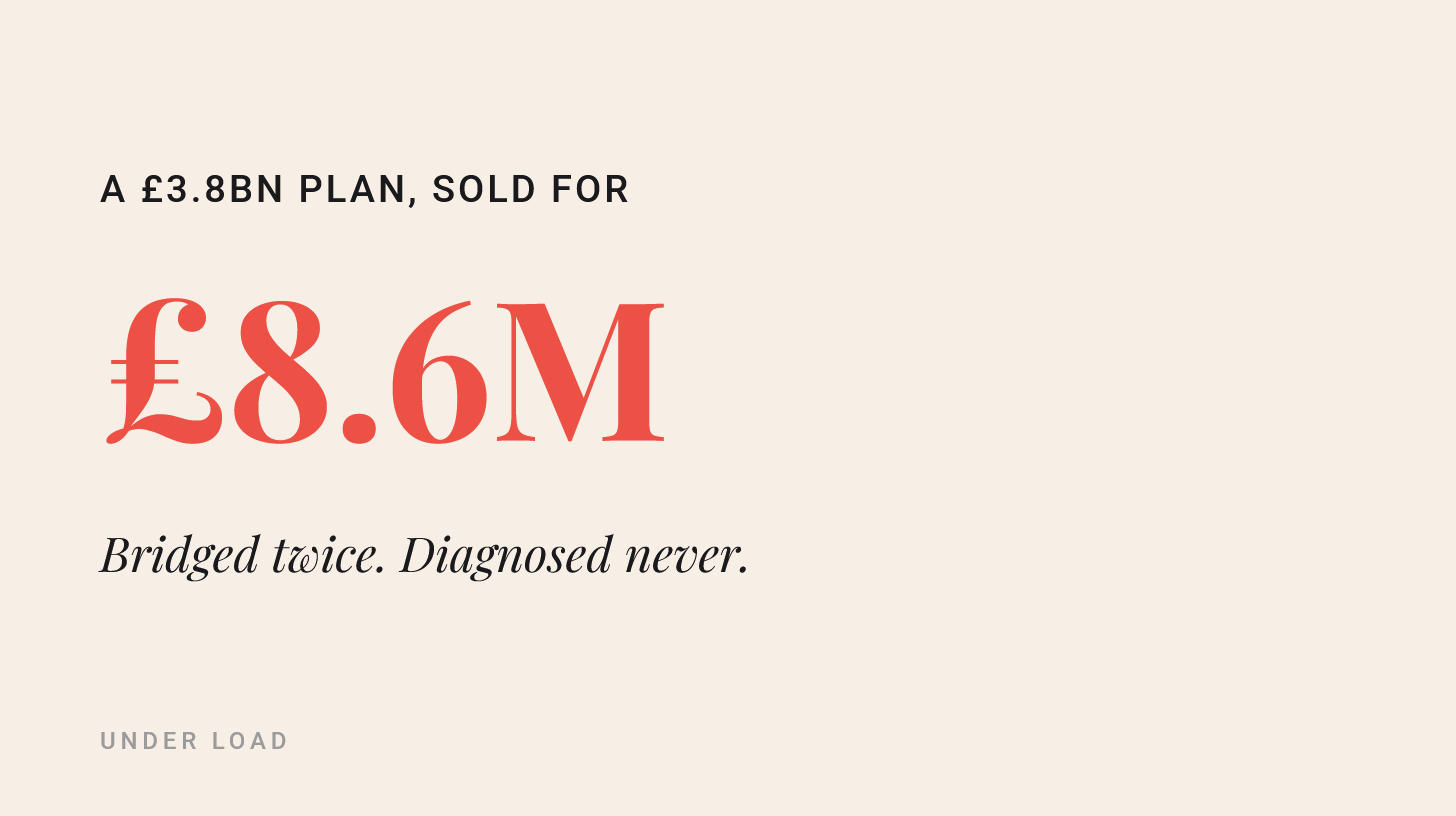
This is not hypothetical. Britishvolt stalled in public view through the autumn of 2022 — bridged twice, diagnosed never. January 2023: administration. Weeks later, its assets sold for a reported £8.6m, against a £3.8bn plan. The bridges bought months. Nobody had established what they were supposed to buy.
On the day you write the check, the two companies are indistinguishable. The board pack cannot separate them mid-raise; your conviction will not — conviction is what carried the position this far, and it argues, always, for one more quarter. So the extension gets made because deciding is hard and extending is easy, and the clock keeps running whether or not you have looked.
Without the read, there is no choice. There is only the clock.
That is the sentence I want to sit on, because it is exact. What feels like a decision — extend or exit, patience or discipline — stops being one the moment you cannot tell the two companies apart. It becomes a default. The clock advances, the runway shortens, and at the end of it something happens to you that you experience as something you chose. A choice requires two distinguishable options and a basis for picking between them. Strip out the basis and the options collapse into one, and the one that remains is simply: wait, and let the clock decide.
A read is what puts the choice back. Not a longer binder, not a second opinion, not more conviction applied to the same fog — a plain, reproducible reading of what is holding the position still, whether capital controls it, and whether a fix clears it. It does one thing to the quiet stall: it separates the fixable company from the structural one, before the extension, while intervention is still cheap. On the first, it hands you the best trade in the book and the evidence to defend it. On the second, it hands you the harder truth early, when early is worth something, instead of late, when the salvage buyer has already priced it.
And it changes the hardest conversation you have — the one across the table from the family office you are asking to co-fund the extension. Their clock and yours disagree by construction: your term pushes toward an exit they may not want, their patience allows a repair your fund life cannot wait for. Two clocks do not negotiate; they just run at each other. A read is the one object both of you can hold at once — the same reading, the same named blocker, for every holder at the table — which is the only honest basis on which a fund and a family office can fund an intervention together without one of them quietly underwriting the other’s timeline.
None of this stops the clock; nothing does. What the read decides is whether it runs while you watch, understanding exactly what you are holding and why — or while you wait, calling the wait a choice. The quiet stall will resolve either way. The only open question is whether it resolves as something you read and acted on, or something that happened to you at a price set by the one buyer who was never in a hurry.
Robert Kellner is co-founder of ClimeNow — Execution Intelligence for capital decisions in Energy & Resilience. Under Load reads what happens when capital meets a scaling company.