

The Four Eras
Cleantech 1.0 supposedly failed on technology. Cleantech 2.0 supposedly failed on policy. Both diagnoses are wrong — and getting them right decides whether the era now beginning succeeds.

Every era of climate investment has been misdiagnosed while it was happening, and the misdiagnosis was never harmless: it decided how the next era’s capital behaved — nowhere more consequentially than in Europe and Germany, where each era’s bill arrived in full: the solar industry lost in the first, the Energiewende champions strained in the second, the growth-stage insolvencies of the third. Three eras in, the pattern is readable, and it reduces to one line: an era is not defined by its technology. It is defined by whether the capital structure, the policy regime, and the operating model are aligned with the physics of the asset class. Every era so far broke on a misalignment nobody was measuring. The fourth era — the one beginning now — is the first with a chance to read the alignment in time.
Era 1.0 · 2006–2011 · Wrong capital model for the asset class
The first cleantech wave lost more than half of its $25bn venture pool by 2015 — the documented outcome of 394 venture-funded companies, not a narrative. Solyndra absorbed more than $1.3bn of private capital and federal loan guarantees before its 2011 bankruptcy. KiOR peaked at a $1.6bn valuation, burned $600m, and liquidated in 2014. MIT’s Energy Initiative later gave the era its correct epitaph in a study title: Venture Capital and Cleantech: The Wrong Model for Clean Energy Innovation.
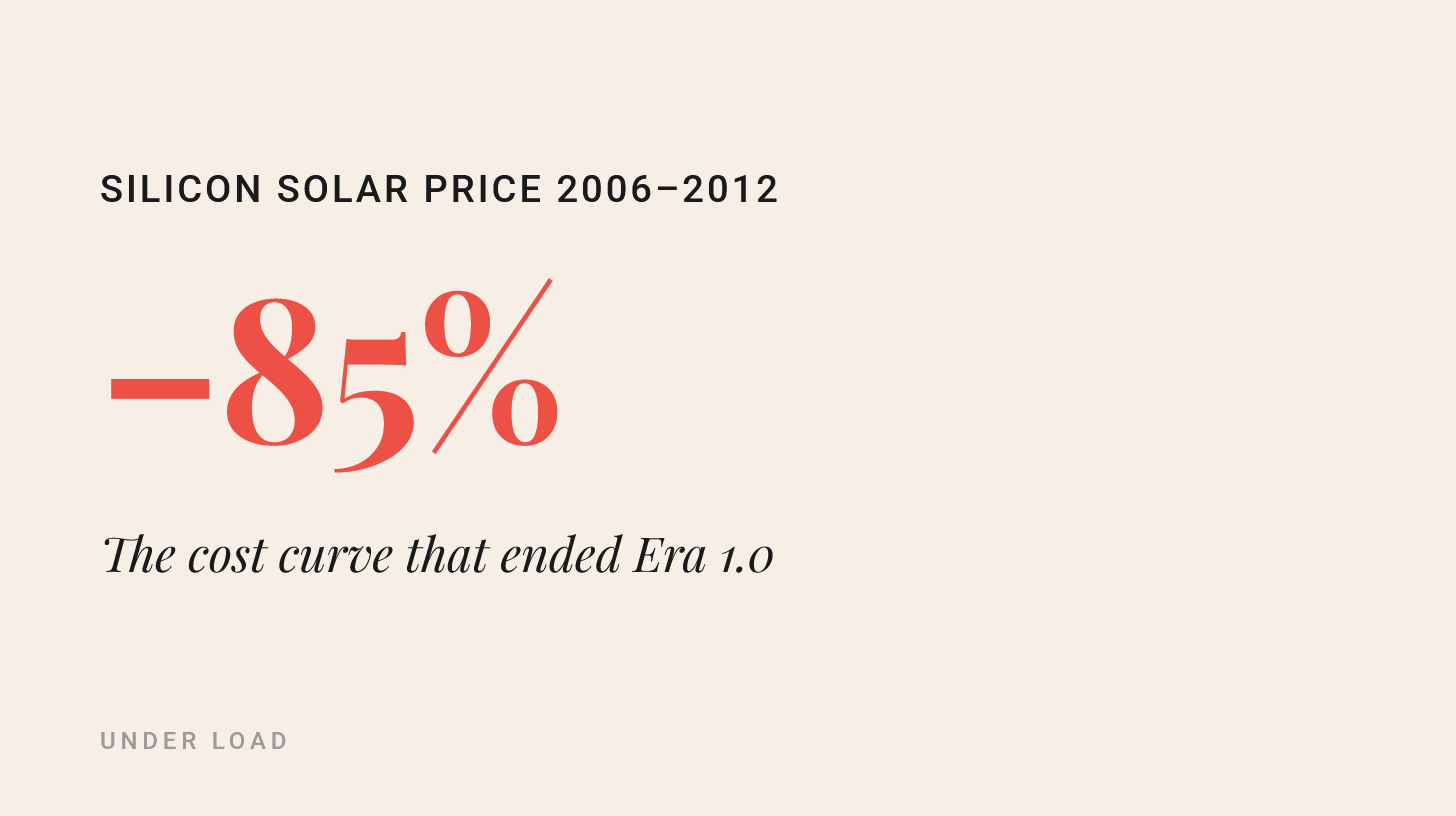
Because the popular epitaph — the technology failed — is wrong. Solyndra’s CIGS chemistry worked. Ivanpah’s concentrating solar worked. What killed them was a cost curve: silicon solar fell roughly 85% between 2006 and 2012, driven by Chinese state-backed manufacturing scale, and the deflation reversed the strategic premise inside the fund holding period. The era had been priced as the next semiconductor cycle. It turned out to be a commodity manufacturing cycle, where the winner is whoever has the cheapest electricity, the deepest subsidies, and the largest fab. China had structurally won that competition by 2011.
Europe didn’t watch that mechanism from a distance — Germany lived it first and hardest. The EEG’s feed-in tariff, from 2000 on, built the world’s leading solar industry: Q-Cells was the largest cell producer on earth in 2008. By April 2012 it was insolvent and sold to Hanwha; SolarWorld followed in 2017; an industry of well over a hundred thousand jobs at its peak was hollowed out inside a decade. The subsidy created the market, the market created the champion, and the cost curve took both — the same physics as Solyndra, experienced not as a case study but as a national industrial loss. For a European capital holder, Era 1.0 isn’t American history. It’s the origin of the home market’s caution, and the first demonstration that a subsidy-built demand curve and a state-scaled supply curve are two different games — and China was playing the second.
The fairness matters here, because the era’s best investors were not fools. Kleiner Perkins turned $1bn into $3bn on selected cleantech bets; Tesla, Enphase, and Nest all emerged from exactly this period, facing equivalent or harder technical questions than the companies that died. Both things are true: individual conviction produced winners, and the aggregate pool lost half its capital. For diagnosing an asset class, the aggregate is the relevant number — and the differentiating variable was never technical soundness. It was capital-structure compatibility: seven-year fund mechanics and IPO-exit assumptions applied to companies that needed twelve to fifteen years and billions in capex to reach commercial proof. The vehicle was wrong for the physics.
One more thing Era 1.0 could not have done, whatever it tried: build consumer climate businesses. AWS reached production reliability in 2008; the app economy arrived in 2009; Stripe was founded in 2010. The infrastructure behind every consumer-facing energy company of the following decade did not exist yet. That was an era constraint, not an execution failure — worth naming, because the habit of blaming teams for era-level conditions starts here.
Era 2.0 · 2012–2023 · Right industries, wrong durability assumption
The standard narrative says Cleantech 2.0 also failed. The standard narrative is wrong, and the misreading is traceable.
By any industrial measure, 2.0 succeeded enormously. Annual global low-carbon investment rose from roughly $50bn in 2005 to $2 trillion in 2024 (BloombergNEF). The IRA catalyzed $493bn in announced clean investment by mid-2024 (Rhodium Group). Solar PV, lithium-ion storage, EVs, and wind crossed cost parity with fossil alternatives in most markets. The decade built the dominant decarbonization industries of the present moment — with ten-year fund mechanics, mature software infrastructure, consumer-facing business models, and a policy environment (feed-in tariffs, EU ETS, the IRA) that was reliably accommodative.
And Europe built as much of it as anyone. Ørsted turned a fossil utility into the world’s leading offshore wind developer; Vestas held the top of the global wind market. Germany’s renewables crossed half of national electricity generation, its households installed more than a million home battery systems, and the industry that grew around them produced real exits at real prices: Sonnen to Shell in 2019, and Viessmann’s climate division to Carrier in 2023 for €12bn — a heat pump business, valued like the strategic industry it had become. The 2.0 decade wasn’t a bet that failed in Europe. It was an industrial buildout that worked.
What failed was one assumption inside the business models: that policy support, once granted, persists. Unit economics of the 2014–2023 vintage carried an implicit ten-year policy-continuity assumption, and that assumption is now visibly false on three continents at once. In the US, offshore wind permits were cancelled, $679m in IRA funds frozen in August 2025, and twenty-six cleantech manufacturing projects worth $27.6bn cancelled in 2025 alone, while key IRA provisions phase out under new legislation. In Germany, the Heating Act was softened mid-2024 after gas-industry lobbying. In China, policy since 2024 has moved to rein in the overcapacity that earlier policy created, while US and EU tariffs tightened foreign market access.
So the honest reading of 2.0: the industries are intact; the durability assumption is dead. Those are different failure modes, and conflating them — “cleantech failed again” — is how capital learns the wrong lesson twice.
Era 3.0 · 2023–2025 · The compound
The third era has what the first two lacked, all at once: the capital exists, the policy frameworks exist, the market demand exists. A snapshot says the three-legged stool is intact. And yet the growth-stage cohort of exactly this era produced the insolvency record the sector is still absorbing. The resolution of that paradox is the era’s defining feature: each leg is present, and each leg is simultaneously more volatile than in any prior era.
Capital: It is still flowing at record levels. Roughly two trillion dollars went into the global energy transition in 2024. At the same time, Europe’s climate funding slumped: in the first half of 2025, it fell by about 70% compared with the year before, from around €22bn to just over €6bn. The part that vanished fastest was late-stage debt. That ballooned category has all but disappeared, with volumes dropping by about 95% after one high‑profile failure scared the market off. The result is a hole in the growth path: Europe now has a large gap at Series B compared with the US, and the funds raised in 2021 are struggling to send money back. By late 2025, only a small share of those funds had returned any capital at all.
Market: global battery storage installations reached 275.3 GWh in 2025, up 61.3% year over year (InfoLink). And in the same market, in the same years: Enpal’s revenue went from €905m to €860m in twelve months; 1Komma5° missed its €750m target by €230m, landing at €520m; German heat pump sales collapsed mid-2024. The market grew and the scaling companies died — and both are one story. The growth landed with actors already past the execution threshold: state-backed champions, mature utilities, established developers. The failures landed in the band between — the Series B–D companies that were supposed to become the next champions. Zoom out and you see a boom. Zoom in and you see a graveyard. Same picture, two altitudes.
And underneath sits the mechanism no operating plan of the era was built for: demand stopped being a function of economics. The German household that panic-bought a heat pump after February 2022 was not buying LCOE — it was buying independence from a hostile gas supplier. Enpal installed 18,000 PV systems in 2022, with demand exceeding installer capacity by an order of magnitude. German heat pump sales hit a record 356,000 units in 2023 — and roughly halved in 2024. Same product, same economics, same climate: the households cancelled not because electricity prices moved (they stayed elevated), but because lobbying softened the Heating Act and the signal of state commitment changed. And here is the part I still find remarkable: the arithmetic never stopped working. Over their lifetimes, an EV and a solar-plus-storage-plus-heat-pump system beat their fossil counterparts in most configurations, even without a cent of subsidy — and a well-run lobby wave kept perfectly responsible citizens from ever doing that math. The signal beat the spreadsheet. That is how effective the mechanism is. Demand in this era oscillates on two coupled psychological signals — an anxiety wave and a lobby wave — at amplitudes and speeds no capacity plan can absorb. One market, three waves in three years: the 2022–23 surge that built order books and installer academies, the mid-2024 collapse that turned that capacity into overhead, the partial 2025 recovery on a permanently lower base.
Which makes the era’s favorite diagnosis — “these teams can’t execute” — a category error. Every tool Era 1.0 lacked, Era 3.0 had in its best version ever: cloud infrastructure mature, the software toolkit complete, capital markets deep — and the talent came. This was the era the sector finally attracted the operators it had always wanted: Northvolt was founded by former Tesla executives; 1Komma5°’s chief executive ran Tesla Germany; the cohort staffed from the senior cadres of automotive and steel. Better tools than 2.0, better teams than any era before it — and the worst growth-stage failure record of all three. And the same failure pattern appears across six segments at once, with the casualties overwhelmingly German and European.
Decentralized energy: Eigensonne, Wegatech, and Sungrade insolvent in the installer wave, Meyer Burger closing its German module production.
Battery manufacturing: Northvolt in Sweden, Britishvolt in the UK, ACC pausing its German and Italian plant builds.
EV charging: Compleo insolvent in Germany, Allego delisted. Building efficiency: Aira cutting back, Thermondo hit by the Heating Act backlash.
Mobility: Sono Motors, Lilium, and Volocopter — three southern-German flagships — insolvent or restructured inside two years.
Industrial decarbonization: Stegra’s production timelines slipping, and S&P revising the EU EV share forecast from 27% to 21%.
When accomplished teams fail simultaneously across unrelated segments, the explanation is not a talent collapse. The environment had become harder to read than the available instruments could measure — and execution is simply the layer where every unmeasured force lands.
Northvolt is the case that carries the era’s narrative because every component fired visibly: $14–16bn raised across fourteen rounds, a $50bn order book at peak, EU policy backing, Goldman, VW, and BMW on the cap table — technology that worked, a market structurally there, policy supportive — and collapse in November 2024, Swedish bankruptcy in March 2025, the proximate trigger a €2bn order withdrawn by BMW in June 2024 after two-year delivery delays. But the diagnosis does not rest on one company.
Remove Northvolt and the population evidence stands: the vintage data, the graduation-rate collapse from Seed to A to B (PwC), the funding-mix implosion, and an institutional consensus that converged within twelve months — “operational rigor will define climate tech” (FTI Consulting, December 2025). A German industry observer had already written the diagnosis in February 2022, in PV Magazine: the technology and the capital are available, but the market lacks execution capacity. The diagnosis is four years old and public.
Era 4.0 · 2025+ · Resilience Tech
The fourth era is not a continuation of the third under a new label, and the difference is testable: labels move marketing; era shifts move capital allocation. What is observable is capital moving — the NATO Innovation Fund, launched in 2023, deploying actively; EIF resilience allocations expanding; multiple dedicated European resilience-tech funds and sovereign resilience mandates launching — ahead of the category even having a settled name. And the largest funding instrument in EU history already carries the era’s name: the Recovery and Resilience Facility, €723.8bn in grants and loans at the centre of NextGenerationEU. Europe’s public capital wrote “resilience” on the door years before the private market named the category.
For a capital holder, the reconfiguration reduces to three practical shifts.
The capital vehicle: the dominant owner type is moving toward long-horizon holders — family offices, evergreen vehicles, industrial balance sheets — whose mechanics finally match the asset class: multi-decade horizons without fund-cycle exit pressure, portfolio postures that absorb individual failures, and a strategic stake in the outcome, because they own the real estate, infrastructure, and industrial assets the investments protect.
The risk posture: after three years of reversals, serious operators now price policy continuity at zero and build for robustness instead — a harder discipline and a healthier one — and they plan for the demand oscillator as a permanent feature, not an anomaly.
The operating discipline: AI-assisted engineering crossed the production threshold in 2024, and small teams now build what previously took large ones — dissolving the white-collar half of the talent constraint that bound Era 3.0. The blue-collar half bound that era hard: 1Komma5°’s forty-plus acquisitions were at bottom an installer-capacity purchase, and Enpal opened a Heat Pump Academy because trained installers did not exist at the volumes the anxiety wave demanded. My operator read is that this constraint eases in 4.0 — from three directions at once: AI-based training that compresses qualification time from years toward months, standardized deployment processes that need fewer people per install, and a next product generation designed to be radically simpler to install than what the field crews of 3.0 were wrestling with. The constraint doesn’t vanish — physical work stays physical — but the era that treats installer capacity as a design problem rather than a hiring problem will not hit the wall of the last one. And the toolkit cuts the other way too: AI models for monitoring, protecting, and managing critical infrastructure are becoming operating capability — the security layer of the resilience stack, not just its build tool.
And the customer’s buying motive is finally being named correctly. The 3.0 anxiety wave already showed it: what households, cities, and industries have been buying is not decarbonization as a virtue. It is resilience — energy independence, hardened infrastructure, secured supply, systems that hold when something hostile happens. The category is catching up to its own customer, expanding from clean energy alone to a spectrum:
climate adaptation (flood barriers, water resilience, heat infrastructure, parametric insurance),
critical-infrastructure hardening (grid, water, hospitals, communications, food systems),
energy sovereignty (decentralized energy as independence, critical-mineral security, domestic supply chains), and
the dual-use edge of monitoring, sensing, and supply-chain visibility.
The strategic weight follows: these companies are not positions to flip. They are the physical layer Europe’s grid, buildings, and industry are being rebuilt on.
What could end it
A defensible era thesis has to name its own failure modes, and 4.0 has six — each echoing an earlier era.
Long-horizon capital could drift back to short-horizon habits as principals retire and governance professionalizes onto consultant-driven mandates — the 2.0 mistake in slow motion, on a ten-to-fifteen-year horizon, and the likeliest failure mode, because institutional discipline tends toward conformity over time.
AI-driven cost advantage could commoditize — everyone gets the same tools, and any company whose moat is “we build cheaper with AI” repeats Solyndra’s cost-curve error with new vocabulary; the durable moats live elsewhere, in regulatory specialization, installer-network density, customer trust, proprietary deployment data, and physical-asset networks.
Resilience demand could be politically captured exactly as decarbonization demand was — a household panic-buys flood protection after one flood and cancels when insurance lobbying delays the mandate; the oscillator does not retire, it changes domain, and resilience is more politically reactive than mitigation, not less.
The talent constraint could reassert itself on the physical side faster than training, process standardization, and product simplification ease it.
Reading discipline could decay into ceremony — assessments run as procedure, findings overridden whenever a deal looks attractive, rigor as ornament.
And geopolitical fragmentation could harden into three incompatible industrial-policy regimes — different standards, supply chains, capital pools, and talent markets — turning one global market into three smaller regional ones; the 1.0 mistake was assuming global commodity dynamics, and the 4.0 discipline is pricing regional concentration into the operating model as strategy rather than as failure.
What success requires
Strip everything else away and the fourth era’s success rests on two conditions holding at the same time.
The first: the capital owners whose mechanics fit the asset class must stay structurally dominant in it. Every prior era failed in part because the dominant capital vehicle mismatched the physics of the assets — the pattern MIT documented after 1.0 in so many words. If the era’s deployment drifts back to short-cycle vehicles under a new label, the mismatch repeats with better branding.
The second: reading before deploying must become institutional habit, not ceremony. Every prior era proves that informal judgment — even the best of it — does not catch the era’s failure mode in time. Conviction at the highest level didn’t catch the 1.0 cost curve. Top-tier institutional diligence didn’t catch the 2.0 durability assumption. The most sophisticated late-stage debt diligence in Europe — €14bn deployed across four anchor deals in a single half-year — didn’t catch the 3.0 oscillator, and Northvolt was funded by the most experienced climate investors and operators on the continent. The gap is structural, and it is independent of how experienced the people are. Whatever instruments this era builds for reading companies under load, the instruments alone decide nothing — the discipline to let a reading constrain a deployment, even when the deal is attractive, is the condition. Either alone is insufficient: patient capital without reading discipline gets caught by the compound more slowly but just as surely; reading discipline without patient capital has no one to act on it.
And at the company level, five disciplines carry forward, one from each hard lesson.
Accept that this is a manufacturing-and-deployment cycle, not a semiconductor cycle, and build moats accordingly.
Stress-test every unit economic against subsidy removal — table stakes now, not sophistication.
Plan for the oscillation as a permanent feature: don’t size capacity to the anxiety wave, don’t shrink it to the lobby wave.
Treat AI as table stakes, never as the moat.
And sell what the customer is actually buying — independence, protection, systems that hold — because they were never buying anything else.
Three eras were misdiagnosed in real time, and each misdiagnosis taught capital the wrong lesson. The fourth era’s advantage is not better technology or more money — both existed last time. Its advantage is that the pattern is finally readable: an era is won by the capital that matches its physics and holds its discipline when the reading is inconvenient. Eras are not survived. They are selected — by every deployment decision that either read the alignment first, or didn’t.
For the companies Europe needs to still be here in ten years, that discipline is the whole game.
Robert Kellner is co-founder of ClimeNow — Execution Intelligence for capital decisions in Energy & Resilience. Under Load reads what happens when capital meets a scaling company.
Sources
• MIT Energy Initiative, Venture Capital and Cleantech: The Wrong Model for Clean Energy Innovation
• Brookings (David G. Victor), How industry is keeping clean energy alive in an era of policy chaos, January 2026
• PV Magazine, “The technology and the capital are available, but the market simply lacks execution capacity”, February 2022
• Bessemer Venture Partners Atlas, Eight lessons from the first climate tech boom and bust
• Cipher News, Looking back to move ahead: Lessons learned from cleantech 1.0
• PitchBook–NVCA Venture Monitor, Q4 2024
• Carta, Q3 2025 VC Fund Performance Report
• World Fund, The Series B Funding Gap in European Climate Tech, January 2026
• Sifted: Climate funding dips 71% in 2025 as debt frenzy ends (July 2025); Enpal, 1Komma5, Zolar: Germany’s solar giants adapt to harsh market realities (May 2025); From pioneer to bankruptcy: The rise and fall of Northvolt (March 2025)
• FTI Consulting, Operational Rigor Will Define Climate Tech, December 2025
• The Recursive, Pilots Succeed, Scale Fails, November 2025
• PwC, State of Climate Tech 2024 and 2025
• ICL Group, Climate Tech Trends 2026: From Hype to Execution
• Rhodium Group / MIT CEEPR, Clean Investment Monitor
• IEA, Global Energy Review 2025
• BloombergNEF, Energy Transition Investment Trends 2025
• InfoLink Consulting, battery storage 2025/2026 outlook
• Canary Media / Wellesley College Big Green Machine, cleantech manufacturing pause/cancel tracker
• S&P Global, EU EV market share revision 2025
• NATO Innovation Fund and European Investment Fund, public disclosures 2024–2025